

PRESS
Gerry Feinstein previews Moby-Dick or The Whale in the V-M BeachComber, September 9, 2026.
Gerry Rush Feinstein is an artist and a volunteer with Vashon Repertory Theatre.
Call me regretful! Until recently I had not read more than a few chapters of Herman Melville’s “Moby-Dick or The Whale.” I’m not exactly sure why. Perhaps I was waiting until I was called to it.
For whatever reason, it was on my DNF (did not finish) shelf for many years until mid-June when I participated in a telephone conversation with Seattle-based director, actor and playwright David Quicksall.
His enthusiasm for the book was contagious, and I was subsequently inspired to read it chapter by chapter from cover to cover. I am beginning to understand why writer E.L. Doctorow called it “the book that swallowed European civilization whole.”
Nearly 17 years ago, Quicksall took on the task of adapting Melville’s epic tale to the stage for a production by Seattle’s thriving Book-It Repertory Theatre.
“I was drawn to adapting sprawling classics like ‘Don Quixote,’ so I proposed that we do ‘Moby-Dick,’” he said. “It was a huge challenge and a complex process. There are books that are easily adapted to the stage. ‘Moby-Dick’ isn’t one of them, but Book-It gave me a few years to sort it all out.”
In the spring, the massive, 40-foot gray whale skeleton artfully installed in the atrium sparked Vashon Center for the Arts executive director Allison Reid’s interest in doing a play about whales.
It just so happened that Vashon Repertory Theatre’s producing artistic director, Charlotte Tiencken, was working at Book-It in 2009 and remembered David Quicksall’s exquisite work on “Moby-Dick” that year.
So, when Reid asked her for ideas, Tiencken sprang into action. It turned out that Quicksall was willing and available — as were several of the original cast members — to restage the play on Vashon. “I am delighted to partner with VCA and include ‘Moby-Dick’ as part of our seventh season on Oct. 16-18,” she said.
“There is far more to this book than a simple action adventure about a bunch of guys hunting down a big fish,” Quicksall notes. “What’s often lost is the book’s inward journey. It took me eight drafts of the script to find those deep places — the lower levels, as Melville called them.”
“The reading of ‘Moby-Dick’ is an experience you need to give yourself over to and just go along for the ride as though you are in Melville’s head,” he pointed out. “Sometimes the book is wildly erratic, and you are exasperated by it. At other times, the language is often Shakespearean and nearly takes your breath away.”
People who are fond of it like to talk about the book, and Quicksall is no exception. Melville scholars and contemporary authors believe that the book was a work of startling modernity ahead of its time. Some are reminded of recent events in which a demagogue promises his followers a huntable enemy.
In addition to his skills as an extraordinary writer, director and actor who has worked for every professional theater company in the Pacific Northwest, Quicksall is well-known as a teaching artist.
As an introduction to both the play and the novel, “Moby-Dick or The Whale,” he will give an informal talk and encourage audience discussion on Sunday, Sept. 20, at 2 p.m. in the VCA atrium. The talk is free to readers of all ages.
Copies of the book are available for purchase from the Vashon Bookshop. Tickets to “Moby-Dick or The Whale” (the play) may be purchased at VashonRepertoryTheatre.org or Vashoncenterforthearts.org.
Greg Heilman of The Sound On Stage reviewed VRTs producton of What The Constitution Means To Me
Stage Review - What the Constitution Means to Me (Vashon Repertory Theatre)
Sep 16, 2026
Written By Greg Heilman
Stage Review - What the Constitution Means to Me
Presented By: Vashon Repertory Theatre - Vashon Island, WA
Show Run: September 10 - September 13, 2026
Date Reviewed: Saturday, September 12, 2026
Run Time: 2 Hours (including a 15-minute intermission)
Reviewed by: Greg Heilman
What the Constitution means to any one person is inevitably shaped by what that person has asked of it. For playwright Heidi Schreck, that relationship began when she was a teenager, traveling to American Legion halls and earning money for college by delivering speeches about the document. Decades later, those competitions became the foundation for What the Constitution Means to Me, a play that starts as something resembling an unconventional civics lesson before becoming much more personal, examining what the Constitution has meant for generations of women and asking whether the protections promised on paper have always existed in practice.
Vashon Repertory Theatre brings Schreck’s Pulitzer Prize finalist and Tony-nominated play to Open Space for Arts & Community, where it ran September 10 through 13 under the direction of Charlotte Tiencken, with Lisa Peretti serving as co-director. The production stars Mik Kuhlman as Heidi, Reed Harvey as the Legionnaire and Mike, and Ari “Reggie” Anderson as the Debater.
The premise initially transports the audience back to Heidi’s teenage years, when she competed in American Legion oratorical contests. As an adult, Heidi attempts to recreate one of those competitions, complete with a Legionnaire keeping time and enforcing the rules, while slipping back into her 15-year-old self. What begins with the optimism and certainty of a teenager fascinated by the Constitution gradually changes as the adult Heidi begins interrupting the recreation. The Constitution she understood as a teenager becomes considerably more complicated when viewed through her own experiences and those of the women in her family.
That transition is one of the things that makes Schreck’s script so effective. What the Constitution Means to Me isn’t simply a lecture about constitutional law, although the Ninth and Fourteenth Amendments receive particular attention. It connects those ideas to women’s rights, immigration, domestic violence and the ways constitutional protections have been interpreted and applied throughout American history. The result is something considerably more personal than its title might suggest. Schreck isn’t merely asking what the Constitution says, rather she’s asking who has historically been able to rely on what it promises.
Mik has an enormous amount to carry as Heidi, both in the sheer quantity of material and in the emotional distance she has to travel with it. She needs to convincingly inhabit the enthusiasm of the teenage competitor without turning her into a caricature, then gradually allow the adult woman underneath that recreation to take control. Those two versions of Heidi begin almost as separate people before the boundaries between them increasingly disappear. Mik handles that evolution well, allowing the humor and intellectual curiosity of the early portions of the play to give way naturally to something considerably more vulnerable.
That vulnerability becomes especially important when Heidi moves away from constitutional theory and begins talking about the women in her own family. The storytelling becomes less performative and more reflective, and Mik doesn’t force those transitions. There is an intimacy to the way she communicates directly with the audience that makes it feel less like watching a character deliver a monologue and more like listening to someone work through what these ideas mean to her in real time. There is no understating the amount of dialogue that Mik needs to recite in this play, and yes, there were less than a handful of times on Saturday when she had to call for a “line”, but while that ordinarily might interrupt the flow, it’s allowable here, for a few reasons. First, all Mik needed was a prompt, upon receiving that she proceeded to move forward like she hadn’t missed a beat. More importantly, though, I’d rather have an actor in a play like this ask for a line to keep her train of thought on track than to stammer or pause, risking misplacing a line here or there and thus altering the context of the conversation.
Reed provides an excellent counterbalance as the Legionnaire. He is very good during his spoken material, but some of his most effective work comes when he isn’t speaking at all. Reed understands how to become almost completely still while Heidi has control of the room, remaining present without pulling focus, then activating immediately when the script requires him again. It’s a subtle skill, particularly in a production this intimate, and Reed’s restraint helps keep the focus precisely where it needs to be.
The physical production wisely avoids competing with the text. Erik Furuheim’s straightforward set establishes the American Legion hall with antlers and a mounted fish decorating the walls, photographs of former members looking down over the proceedings, and little more than a podium and table occupying the playing space. It immediately establishes the kind of room in which teenage Heidi would have delivered these speeches, while leaving enough visual simplicity for the play to move beyond that memory.
Chris Lubitz’s lighting becomes particularly effective as that transformation occurs. The brighter illumination of the Legion hall supports the public, performative quality of Heidi’s competition speech, while softer and more focused lighting accompanies the moments when she steps outside the competition and reflects on something more serious or emotional. Rather than announcing those shifts, Chris allows the lighting to quietly help focus the audience’s attention and change the emotional temperature of the room.
The production eventually abandons the recreation altogether. Heidi’s examination of a document written centuries ago gives way to an actual debate about what should happen to it now, bringing Ari into the production as the teenage Debater. It’s an important structural choice in Schreck’s play, after spending so much time examining what previous generations created and how those decisions affected the generations that followed, the final argument belongs to someone from the generation that will inherit it.
That makes What the Constitution Means to Me less interested in supplying an answer than in creating a conversation, a refreshing idea in a world where there is so little of that happening. The Constitution can simultaneously represent an extraordinary expansion of individual rights and a document whose protections have not historically been experienced equally by everyone. Schreck allows those ideas to exist alongside one another, asking the audience to wrestle with that contradiction rather than resolving it for them.
Vashon Repertory Theatre’s production understands that the most effective way to make that argument isn’t by overwhelming the audience with theatricality. Directors Charlotte Tiencken and Lisa Peretti keep the storytelling direct, allowing the actors to make something written about constitutional amendments feel distinctly human. In doing so, the production returns repeatedly to the question contained in the title. What the Constitution means isn’t necessarily the same thing to everyone, and perhaps the most important part of the question is continuing to ask it.
The Vashon Repertory production of What the Constitution Means to Me has closed, but the learn more about the organization, including upcoming productions, visit https://www.vashonrepertorytheatre.org/.
Review: “Edgar Sawtelle” revives Book-It Repertory’s legacy
By Aspen Anderson For The Beachcomber • October 16, 2024 1:30 pm
From the start, audiences are immersed in the world Wroblewski so evocatively created in his book.
Tracy Hyland as Trudy, Edgar’s mom, and Jen Taylor as Almondine the dog welcome the newborn Edgar, starting a lifelong bond. (Michelle Bates photo)
After closing its doors in 2023, Seattle’s Book-It Repertory Theatre, a beloved institution known for bringing literature to life on stage, is making a comeback.
Through a partnership with Vashon Repertory Theatre, Book-It’s style returns in a world premiere adaptation of “The Story of Edgar Sawtelle,” now running at Vashon Center for the Arts.
Directed by Book-It co-founder Jane Jones and co-adapted alongside Kevin McKeon, who also serves as the set designer, this production marks a significant moment for both theaters. With its roots planted in literature, the revival of Book-It’s work through this adaptation allows Wroblewski’s haunting tale to take on new life.
Set on a rural 1970s Wisconsin farm, “Sawtelle” explores the bond between Edgar, a mute boy, and his loyal dog, Almondine, as well as the unraveling of a murder that upends their dog-breeding farm.
The play adaptation is based on a David Wroblewski book of the same name which Jones read 15 years ago.
“I was entranced by the relationship of a boy and a dog — on a farm in Wisconsin — a boy who did not speak and a dog who could not speak, but nonetheless created a beautiful language that they understood perfectly,” wrote Jones in the playbill.
From the start, audiences are immersed in the world Wroblewski so evocatively created in his book.
Costume designer Tesse Crocker, who grew up on a farm, chose simple, well-fitted overalls for much of the cast and a denim dress with ruffles paired with a bright blue bandana that perfectly captures the “farm mom” essence for Trudy, played by Tracy Hyland.
“Work wear is a huge part of farm life,” Crocker said in a video shared by Vashon Repertory Theatre’s Facebook. “Simplicity … is necessary in telling such an epic tale that travels many years in moments.”
Stepping into the theater, I was immediately struck by the set’s warmth — wooden furniture, soft lighting and scattered hay evoked a farm life reminiscent of Vashon’s own character.
The stage design mirrors the simplicity of rural living, with minimal but carefully chosen pieces, such as the downstage left rocking chair and the towering barn door upstage. A simple false door with a working porch light subtly marks transitions. The set creates a rich yet understated visual canvas.
The play opens with a bold choice: Almondine, the beloved family dog, is the first to speak.
This unusual choice immediately put me on edge — how does one pull off a talking dog in a serious play? But Jen Taylor’s performance as Almondine is masterful and quickly reassuring. Taylor is steady, warm and she commands the stage with ease, making Almondine a character you can trust.
At the heart of the story is the deep bond between a boy and his dog — Edgar, played by Christopher Morson, and Almondine. Morson’s portrayal of Edgar — a boy who communicates through his own invented sign language — is inspired.
Morson’s performance deserves high praise. The amount of story he conveys without words is jaw-dropping. He sees so much, and brings you into all of it.
His emotions — frustration, envy, love, and pride — are palpable. His expressive face and physicality drew me into every moment and never left me wishing for dialogue.
The play thrives on these subtle, poignant moments.
One of my favorite scenes takes place around the family’s kitchen table, playing cards. These moments, where not much plot unfolds, seem to be the backbone of every production, drawing you into family life that is universally familiar and life-affirming.
The tropes of the “troubled son,” the drunk uncle, the questionable cop and the wife who moves on a little too quickly all work seamlessly in this story.
A moment should be taken to appreciate how the cast skillfully seems to use the entire negative space on stage, with much credit to the four “dogs” often crawling around. This is no easy feat, but it creates an extremely dynamic atmosphere.
In my jumbled notes from the show, I wrote “piano man!” with a heart next to it more than once. The live music and sound effects bring the story to life, created and played by Edd Key, the piano man and music director, shines.
Matthew Synthandone’s performance as Tinder, one of the family’s dogs, was another standout. His mannerisms and physicality — complete with an adoring gaze and awkward leg jiggles — were so convincingly canine that I almost believed he was a dog in a past life.
More than just a story about a boy and his dog, “The Story of Edgar Sawtelle,” is a meditation on the human experience — grief, pride, and our shared but painful inability to forgive until it’s too late.
One line in particular stands out: “Edgar felt as he looked out the window, if he could catch the trees motionless for one second, for half a second, if they stood wholly at rest for the briefest moment, and none of this would have happened.”
We’ve all experienced that moment when we wish time could stand still, refusing to acknowledge that everything has already changed. Edgar’s delivery of this line bottles that feeling perfectly, capturing the heart-wrenching desire to freeze and hold onto life before tragedy strikes.
Despite the play’s heavy themes, there’s humor, too — much of it delivered by Dr. Papineau, played by Chris Boscia. His comedic timing provided welcome moments of relief in a production steeped in loss and melancholy.
Oh, and let me mention again that this story is also a murder mystery — you’ll have to watch to find out whodunit.
With performances running through October 20 at the Vashon Center for the Arts, “The Story of Edgar Sawtelle,” is a must-see for anyone who cherishes theater’s power to transport us—whether through words, silence, or the love between a boy and his dog.
And how sweet is that Vashon Rep — so ably led by islander Charlotte Tiencken — has played this role in the revitalization of the beloved Book-It Repertory Theatre, which was so cruelly silenced by the pandemic and financial losses, is back.
Don’t miss the show.
October 11, 2024
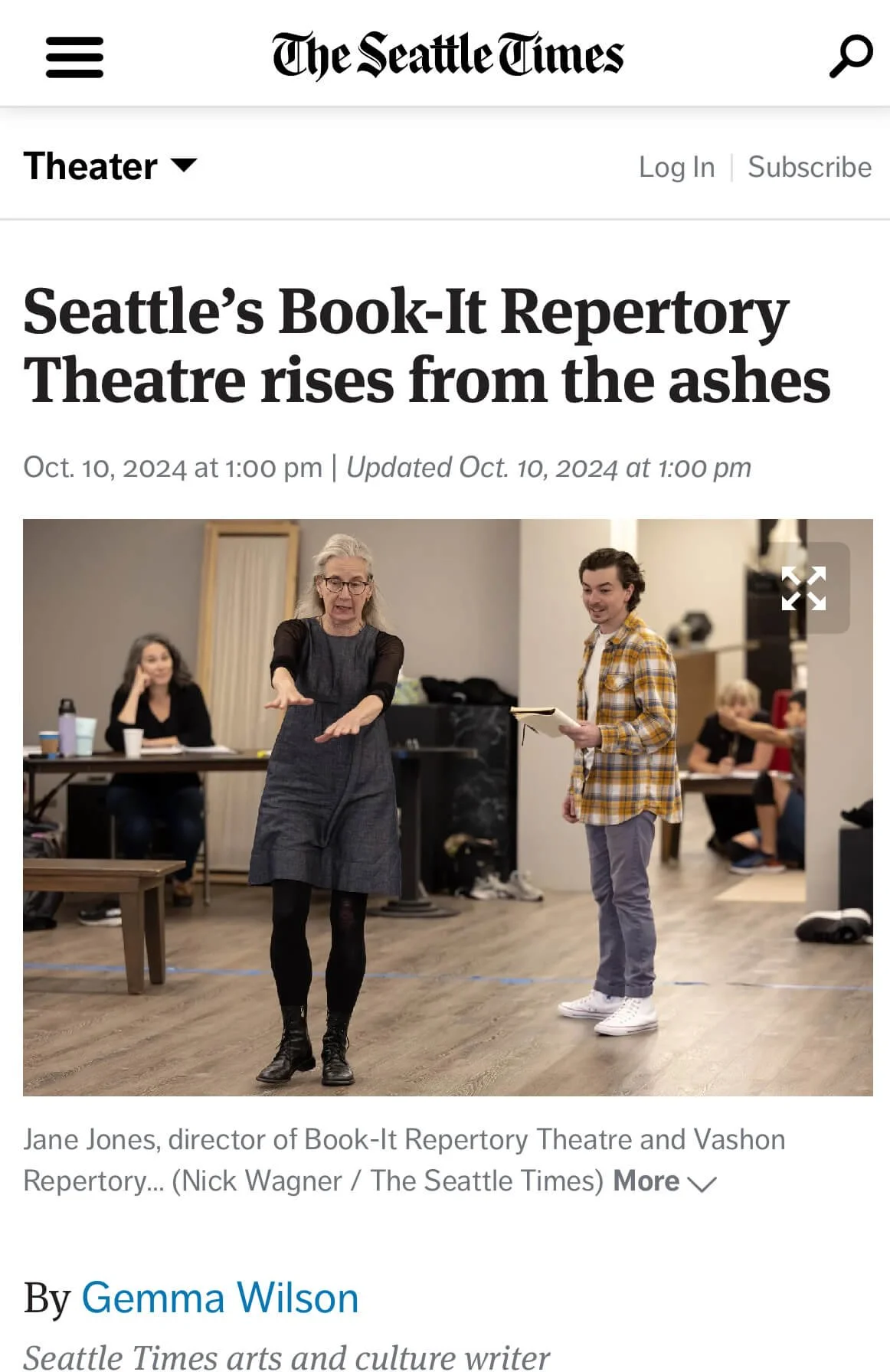
After closing in 2023, Seattle’s venerable Book-It Repertory Theatre, which for 33 years created vibrant theater from works of literature, is slowly rising from the ashes.
Read more
March 7, 2024
Vashon-Maury Island BeachComber
“Love is the story and the prayer that matters the most.”
– from “The Wet Engine: Exploring the Mad Wild Miracle of the Heart”
“Maybe we guzzle forty stories with every breath we draw and they soak into us and flavor and thicken and spice the wild stew we are.”
– from “A Shimmer of Something: Lean Stories of Spiritual Substance”
“Kissing the Joy as it Flies: The Wit and Wisdom of Brian Doyle,” a theatrical bouquet fashioned from the late author’s dazzling observations about being human, is about to bloom again on Vashon.
The show, a deft and fast-paced adaptation of Doyle’s essays, short stories, novels, and letters, was written by islanders Mike and Gerry Feinstein and had its debut at Vashon Center for the Arts (VCA) in 2019.

UMO Ensemble has already performed its show, “Fail Better,” outdoors, in a New York City parking lot. Now, the ensemble will bring the show to an outdoor stage, at Open Space for Arts Community, during this summer’s Vashon Repertory Theatre Fest.
MAY 13, 2021
Vashon Maury Island Beachcomber
The Shows Must Go On: Live Theater Returns This Summer. A summer festival featuring four productions held on multiple stages is on its way, and there’s more.
Read more

Mik Kuhlman (top), David and Janet Godsey (bottom left) and Maria Glanz (bottom right) are part of the cast of “Savage/Love”.
FEBRUARY 11, 2021
Vashon Maury Island Beachcomber
Local Sweethearts Present Theatrical Treat for Valentines “Savage/Love” will be presented in a one-time-only broadcast at 7:30 p.m. Saturday.
Read more

OCTOBER 26, 2020
Vashon Maury Island Beachcomber
Review: Local troupe lights up the dark with radio drama, ‘Home’ Seven short new radio plays made their debut on Vashon Center for the Arts’ website on Oct. 8.
Read more